
Seeing a child nursing makes one so appreciative of how well the human body is designed so that breastfeeding gives the child nourishment while at the same time fostering the loving bond between the mother and the child.

Initially you will see this in the way the baby learns to love the breast. I can remember when my baby first learned to smile. The very first times she smiled, she did so when she saw the beloved breast being dug out of the shirt for her to feed on!
Breast is the central focal point of your baby's life. It is NOT just a food source but a source of comfort and security. It is soft and warm to feel and to baby's mouth, which a bottle certainly isn't. Baby feels safe and secure at Mommy's breast.
“Women need to know that breastfeeding quiets a noisy or fussy child, relaxes an
anxious child, comforts a sick, injured, or frightened child, and conveys
unequivocally that the child is safe and loved.”
Katherine Dettwyler in Breastfeeding: Biocultural Perspectives, p. 203.
The breast is baby's natural pacifier and security blanket!
Breastfeeding is a natural way of bonding with your child. Nursing and holding the child close causes the brain to release a hormone-like substance called oxytocin. Its release is especially pronounced with skin-to-skin contact. This hormone has been called the "love hormone" or the "cuddle hormone" or the "bonding hormone". It provides a sense of calm and well being and helps the mother and child to bond together. It is involved in those mothering feelings we experience after giving birth to a child. (Oxytocin does NOT make breastfeeding a sexual experience as some erroneously believe.)
Breastmilk contains a wonderful hormone called cholecystokinin (CCK), which induces sleepiness, both in the baby and the mother. It is the easiest method to help your child sleep.
"Other children form attachments to comfort rags, toys, dummies and even a bottle, objects that can all be mislaid, forgotten or lost. The beauty of breastfeeding is that my daughter's source of comfort is permanently attached to me and, besides, as far as I am concerned, anything that has the ability to pacify a restless child in the evening, and particularly at 2am, is a blessing! She falls asleep within a couple of minutes of latching on, whereas I have heard friends complain about having to spend long periods of time performing bribing rituals in order to get their children to go to sleep."
Jan Andersen, in Are You Still Doing That?

Yet one more benefit of breastfeeding is that the suckling motion helps develop babies' lungs. The sheer physical effort involved in nursing may leave babies with better lung function well into childhood, as found by research.
These good points won't cease at 6 months or at one year. To many people in the US, the idea of a 2-year-old toddler climbing into Mommy's lap and asking to nurse is a foreign and uncomfortable concept. But to the mothers who do it, breastfeeding a toddler is a natural and healthy part of raising children. Nursing can help your child during emotional upsets or family crises, or just simply through teething. Besides, if we are to believe our children, toddlers (who can talk) invariably appreciate breastfeeding!
"...the two-year-old who, having fallen and then nursed, amply rewarded her mother by saying, 'Thanks, Mom, for nursing me. Bye now, I'll be okay.' "
Norma Jane Bumgarner, in Why Mothers Nurse Their Children into Toddler-hood
"As for Kevin, he has never been sick (ever...honestly!), is a wonderfully good-natured child, and is independent, loving, affectionate, funny, intelligent and calm. His security in my love for him is absolute, and this extends other facets of his life. He is attached and safe and sees the world as a loving, nurturing place. I believe that the closeness of breastfeeding, from the hour of his birth, fosters this."
Laurie Flanagan, mom to nursling Kevin, 16 mos
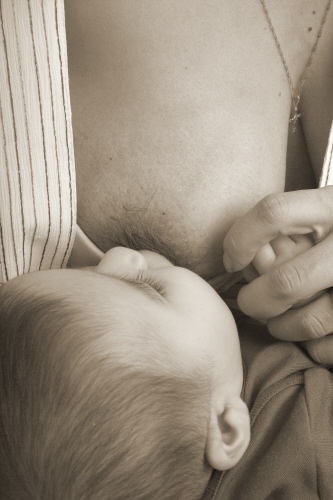
Breastfeeding works best when it is done "on demand", in other words whenever the baby wants to or shows cues of wishing to nurse. That can even mean up several times an hour in the beginning.
Why is that? First of all, infants have very small tummies and breast milk digests quickly, so the smaller the baby, the quicker she will be hungry again. Also, babies don't nurse for food only but also for comfort and security.
Dr. Hartmann has studied human milk production in detail. In his study the woman with greatest storage capacity could store 3 times as much milk as the woman with least capacity. This means that women with small breasts (small storage capacity) should naturally nurse more often! The wonderful part is that your baby will tell you when you need to nurse him/her, so you don't really have to worry about how much your breasts can store!
Also, if you nurse strictly on a schedule, you may experience milk supply problems after about 3 months of nursing. This seems to stem from the fact that in the early months the milk-producing hormone prolactin plays an important role building the milk supply, but after that a different process, autocrine or local control, takes over.
It appears that this different process works if you developed adequate prolactin receptors during the first months—and that depends on how often you feed the infant: the more frequent the feeds, the greater the stimulation of receptor development.
It is also known that the fat content of human milk varies during a feeding. The milk that the baby first gets from a full breast has less fat than the "hindmilk" that he gets towards the end of the feeding. It is fat that makes the baby feel satisfied and full after a meal. If the nursing time is cut short, the baby does not get the fatty hindmilk, and may be fussy right after nursing.

A free graphic for you to use from "I Heart Topfreedom" blog.
Have you considered how economical it is to breastfeed? The estimated saving from buying formula during the first year is between $714 and $2857 depending on the price of infant formula.
You might have health insurance, but the nation would save enormous amounts in health care costs if children were breastfed more. It has been estimated that a minimum of $3.6 billion would be saved if breastfeeding levels were increased from current levels (64% in-hospital, 29% at 6 months) to those recommended by the U.S. Surgeon General (75 and 50 percent). That is based solely on the costs of treating three childhood illnesses, which breastfed babies contract much less than formula-fed ones.
But in addition to saving money, maybe we should also consider the more than 9,000 lives which would be saved annually if all babies in US were breastfed. A health expert Dr. Linda Folden Palmer has examined the available scientific research, comparing the death rates of formula-fed and breastfed babies, and found that the infant mortality rate is approximately DOUBLED by the usage of formula.
Breastfeeding affects mom's health positively in many ways. For example, nursing helps moms shed pregnancy pounds quickly — nursing consumes up to 500 calories a day! It also reduces the risk of diabetes, breast cancer, ovarian cancer, and uterine cancer. And, breastfeeding is relaxing to the mother (when nursing goes well). New moms of course have a lot to adjust to – please see these helpful coping tips for new moms for some help!
Many pregnant women assume that breastfeeding comes "naturally" and that it is easy from the first day on, so they are very disappointed if the reality is different. The fact is that breastfeeding is LEARNED - both by mom and baby. Learning the proper latch may take just a few moments or it may take weeks, and while you nurse with the wrong latch, that can hurt your nipples. You may also have other problems. STUDY about breastfeeding while you are still pregnant so that you know what to expect and where to find help.
In times past when all women breastfed, a new mother had plenty of other women around her giving her support and advice in this new task. Today, if your relatives or friends can't "coach" you with nursing, there is still lots of help available: nurses, lactation consultants, La Leche League groups, different online communities and message boards, helplines, and several fine websites with lots of information.
So if breastfeeding is problematic, do NOT suffer alone , but find help before starting a supplemental bottle, or assuming that you just don't have enough milk, or that you just can't breastfeed, or that your baby just won't learn to latch on, etc.